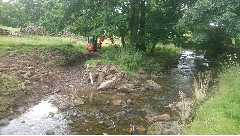
Residents may have noticed the recent appearance of a short, excavated channel seemingly connected to Lothersdale Beck downstream of the mill where the footpath ‘hangs in the balance’. Here’s the rationale for its construction.
Lothersdale Beck has been heavily modified at obvious points throughout the village such as the dam(s) and culverting around the mill yard for historic hydropower. However, perhaps less obvious are the more subtle modifications where the Beck has been pinned in position within the valley to accommodate, for example, road infrastructure, larger areas of field, or the football field and MUGA in the park.
A straighter channel is steeper and transports water more quickly from A to B, thereby increasing erosive power. With changes to the frequency and severity of storm rainfall events, some erosion hotspots have become more prominent in the last few years. One such area is the popular footpath downstream of the mill where the bank has been taking the brunt of flow directed at it (ie at the end of a straightened reach) for decades. Continual trampling and grazing by sheep further maintains the bank in an unstable state, more susceptible to future spate flow.
A bird’s eye view of the valley there reveals multiple, meandering ‘paleo-channels’, ghosts of past paths of the Beck. A short section of one of these has been recently re-excavated to help reduce the erosive power at the contentious point where the footpath hangs precariously above the channel.
The idea is not to forcefully divert the beck (which would require negotiating considerable Land Drainage Consent red-tape) but to work with natural processes to encourage it to shift back to one of its former paths. This does not entail so much paperwork and could be achieved with funding for environmental gain via our resident fish guy, Prof Jonny Grey and the Wild Trout Trust, and with consent from the landowners of course.
Now, when the Beck rises, a proportion of the flow is routed down the new ‘old’ channel and therefore reduces the erosive force at the footpath. Over time, a greater proportion will be routed that way, and potentially all of it may shift in due course. Thus, it does not help rebuild the footpath (which is being discussed by the landowner with the PROW Officer at North Yorks CC) but it will help slow the degradation of the bank and may buy some time for alternatives to be sought.
A short video of the first flow down the channel is available here: https://youtu.be/K6cq8_V0jtI – check out the frantic slug and snail activity!